
Introduction: Two Distinct Tax Strategies
If you own a home in Canada or Quebec, you have probably already looked for ways to improve your financial situation and reduce the cost of your mortgage. Two strategies come up often: the Smith Manoeuvre and MAPA (Mise à part de l’argent, or setting money aside). They are two distinct tax strategies: both aim to make otherwise non-deductible interest deductible, but they work in completely different ways and suit different profiles.
This article explains both concepts in detail, their benefits and risks, and how to determine which one best suits your situation.
What Is the Smith Manoeuvre?
Definition and Basic Principle
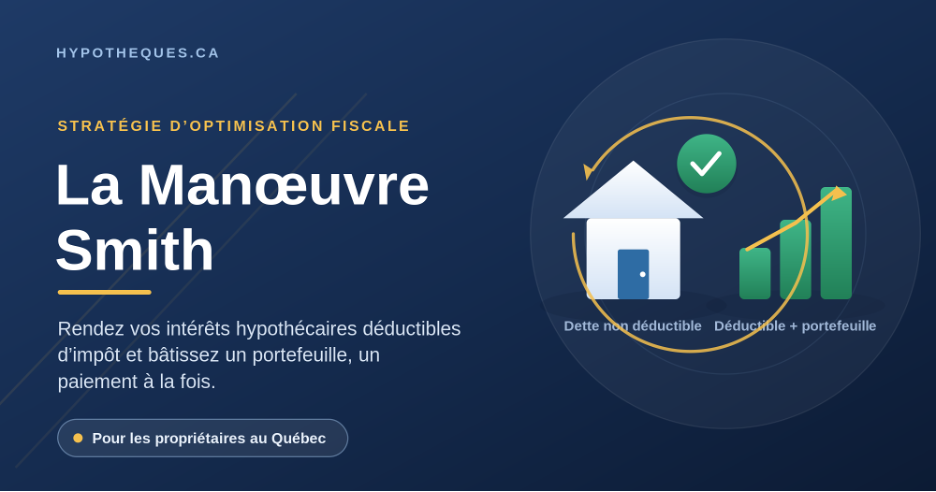
The Smith Manoeuvre is a legal financial strategy created in Canada by Fraser Smith. Its main goal is to convert your non-deductible mortgage debt into tax-deductible debt while building an investment portfolio.
How Does the Smith Manoeuvre Work?
The strategy relies on a fundamental feature of the Canadian tax system: interest on money borrowed to earn investment income is tax-deductible, while interest on your personal mortgage is not.
Steps
- Get a readvanceable HELOC
A product that combines a mortgage with a line of credit that increases automatically as you pay down principal.
Example: On a $300,000 mortgage, you pay $1,000 of principal this month → your available credit increases by $1,000. - Borrow from the line of credit each time you repay principal.
- Invest the borrowed money in income-producing investments (dividend stocks, ETFs, funds, etc.).
- Deduct the interest paid on the portion of the line used to invest (according to CRA rules).
- Reuse the tax savings to speed up repayment, invest more or improve cash flow.
Numerical Illustration (Simplified)
- Starting point: $300,000 mortgage — $1,800 payment ($800 principal / $1,000 interest) — 40% marginal tax rate
- Month 1: Principal ↓ by $800 → you borrow $800 from the line of credit → you invest $800
- After 1 year: $9,600 invested through the line of credit — Interest at 5% ≈ $480 → Tax savings = $480 × 40% = $192
- After 20–25 years: Mortgage paid off, portfolio built up, debt now mostly deductible.
Key Requirements
- Enough equity for a readvanceable line of credit
- Stable income to pay the interest
- Risk tolerance and a long-term horizon
- An understanding of the markets or professional guidance
- Discipline and rigorous record-keeping (traceability)
Important: Not All Lines of Credit Are Compatible
Key Features of a Suitable Line of Credit
- Automatic readvance of credit with every principal repayment
- Separate sub-accounts (deductible investment borrowing vs. other uses)
- A structure that meets CRA tax-traceability requirements
- Fast access to readvanced funds
- Competitive rates
Mistakes to Avoid
- Using a standard, non-readvanceable line of credit
- Failing to properly separate borrowings (puts deductibility at risk)
- Choosing a product without understanding its limits
- Neglecting supporting documentation (CRA)
Work With an Accredited Broker
Given the complexity, get support from a mortgage broker accredited in the Smith Manoeuvre. They can:
- Assess your eligibility and steer you toward the right products
- Structure your financing in line with CRA rules
- Coordinate with your accountant or financial advisor
- Help you avoid mistakes that jeopardize deductibility
Benefits of the Smith Manoeuvre
- Tax: interest deductions, converting non-deductible debt → deductible debt
- Financial: a portfolio built without “new” savings, growth potential, faster mortgage repayment
- Wealth: net worth ↑ and diversification beyond real estate
Risks and Drawbacks
- Investment: volatility, possible short-term losses
- Financial: overall debt ↑, interest to pay, sensitivity to rate increases
- Tax: rules may change, traceability required
- Complexity: administrative follow-up, need for professional support
What Is MAPA (Mise à part de l’argent)?
Definition
MAPA (mise à part de l’argent, or “setting money aside”) is a tax strategy that is distinct from the Smith Manoeuvre. It is designed for unincorporated self-employed workers, owners of unincorporated businesses and rental property owners. It consists of converting non-deductible personal debt (such as the mortgage on your home) into business debt whose interest is tax-deductible. The CRA has recognized this technique as legal since 2002.
How It Works
- Separate your cash flows: open two distinct accounts, an “income” account and an “expenses” account.
- Business or rental income goes into the income account and is used to pay down the mortgage and personal expenses.
- Business expenses are paid with borrowed money (a line of credit or dedicated loan) tied to the expenses account.
- Deduct the interest on that borrowing, since it is used to earn business or rental income.
Numerical Illustration
- Self-employed worker: $100,000 gross income per year, $50,000 in business expenses per year, $100,000 home mortgage
- Year 1: business expenses are financed with borrowed money (deductible interest) and income goes toward paying down the mortgage
- After about 24 months: the non-deductible mortgage is paid off and replaced by roughly $100,000 of business debt whose interest is deductible
Benefits
- Tax: interest is deductible from business or rental income
- Faster repayment of your personal mortgage
- No stock market investing required: your total debt doesn’t grow, it changes nature
- A technique recognized by the CRA
Drawbacks and Limits
- Only available to self-employed workers, unincorporated businesses and rental property owners
- Requires discipline and rigorous traceability (separate accounts, no mixing of funds)
- Savings depend on your marginal tax rate and the interest rate on the borrowing
- Working with an accountant or tax specialist is recommended
Learn more: the MAPA tax strategy explained.
Smith Manoeuvre vs. MAPA: Comparison Table
| Criterion | Smith Manoeuvre | MAPA |
|---|---|---|
| Complexity | High | Moderate |
| Risk level | High (markets) | Low (no stock market investing) |
| Tax benefits | Yes (deductible investment interest) | Yes (deductible business interest) |
| Mechanism | Borrow to invest in the markets | Borrow to pay business or rental expenses |
| Debt level | Increases temporarily | Total stays stable: the debt changes nature |
| Target profile | Experienced homeowners and investors | Self-employed workers, unincorporated businesses, rental property owners |
| Administrative follow-up | Significant | Significant (separate accounts) |
| Professional guidance | Strongly recommended | Recommended (accountant/tax specialist) |
| Time horizon | Long term (20–30 years) | Short to medium term (conversion over a few years) |
| Impact on net worth | Potentially accelerated growth | Mortgage paid off faster, lower taxes |
| Product requirements | Specific readvanceable line of credit | Business line of credit or loan + separate accounts |
Which Strategy Should You Choose? Decision Guide
Consider the Smith Manoeuvre if you have:
- A good understanding of the markets or a trusted advisor
- A stable, comfortable income
- High risk tolerance and a horizon of more than 20 years
- A desire to maximize wealth and tax benefits
- The discipline to follow a complex strategy
- Substantial equity (≥ 20%)
- Support from an accredited broker
Consider MAPA if:
- You are self-employed, run an unincorporated business or own a rental property
- You have regular business or rental expenses
- You have a home mortgage whose interest is not deductible
- You don’t want to invest borrowed money in the stock market
- You are ready to keep separate accounts rigorously
Can You Combine the Two?
- Yes. They are two distinct strategies that can complement each other: MAPA converts your mortgage into business debt through your business expenses, while the Smith Manoeuvre converts it into investment debt.
- Each loan must stay clearly separated and documented; have the structure validated by an accountant or tax specialist.
Legal and Tax Considerations in Quebec
Smith Manoeuvre
- Rules set by the CRA (federal) and Revenu Québec (provincial)
- Interest is deductible (federal + provincial) if traceability is maintained
- Keep proof of the link between borrowing → investments
- Consult a tax specialist/accountant
MAPA
- Legality recognized by the CRA since 2002
- Interest is deductible only if the borrowed money is used directly to pay business or rental expenses
- Keep separate accounts and all supporting documents
- Consult a tax specialist/accountant
Frequently Asked Questions (FAQ)
Is the Smith Manoeuvre legal in Canada?
Yes, as long as the deductibility rules are followed and traceability is maintained.
Do all lenders offer the readvanceable line of credit you need?
No. And not all of them are compatible. That’s why working with an accredited broker (e.g., Vincent Le Saux, hypotheques.ca) matters.
Can I stop the Smith Manoeuvre partway through?
Yes, at any time, depending on your revised goals.
Are MAPA and the Smith Manoeuvre the same thing?
No. They are two distinct tax strategies. The Smith Manoeuvre makes interest deductible by investing borrowed money in income-producing investments. MAPA makes it deductible by using borrowed money to pay business or rental expenses, which frees up your income to pay down the mortgage.
Who can use MAPA?
Unincorporated self-employed workers, owners of unincorporated businesses and rental property owners who have business expenses.
What happens if the market crashes during the Smith Manoeuvre?
Your portfolio could genuinely drop in value temporarily, but the interest is still owed. The strategy is recommended over 20–30 years.
How can I make sure my line of credit is compatible?
Consult an accredited broker (e.g., Vincent Le Saux, hypotheques.ca) to validate the product and structure.
Conclusion: Choose Based on Your Profile
The Smith Manoeuvre (an investment strategy, tax-optimized) is for savvy homeowners who accept complexity and market risk. MAPA (no stock market investing) is for self-employed workers and rental property owners who want to convert their mortgage into deductible business debt. There is no one-size-fits-all solution: it all depends on your risk tolerance, your knowledge, your situation and your goals.
Final Recommendations
- Consult a broker accredited in the Smith Manoeuvre to assess your eligibility and find a compatible line of credit
- Talk to an accountant/tax specialist about the implications
- Honestly assess your discipline and time horizon
- Start small if you choose the Smith Manoeuvre
Contact a Specialist
Vincent Le Saux, mortgage broker accredited in the Smith Manoeuvre — hypotheques.ca. He can help you:
- Assess your eligibility
- Recommend compatible products
- Structure your financing optimally
- Handle implementation and follow-up
- Answer your questions about the Smith Manoeuvre and MAPA
Not sure which strategy fits your goals? Book a free 30-minute consultation with our mortgage broker team to find the approach that best aligns with your objectives.