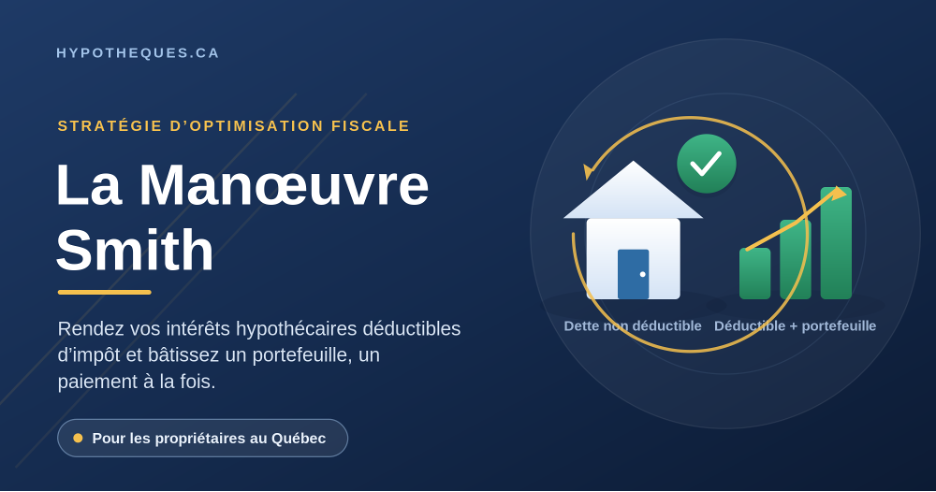

Key idea: it is possible to claim two tax deductions using the same amount, provided you follow a very specific sequence involving the RRSP, the Home Buyers’ Plan (HBP), and the FHSA. The Canada Revenue Agency treats this as two separate transactions, which is why the strategy is allowed.
Why this strategy can be worth considering
In a typical scenario:
- An RRSP contribution reduces your taxable income.
- An FHSA contribution also reduces your taxable income.
What makes this approach different is that you can make the same dollars work twice: you contribute to your RRSP, then reuse that same amount to contribute to your FHSA, while receiving two deductions.
You can even take it one step further. If everything is done correctly, the double deduction can apply in the same tax year, maximizing the immediate impact on your taxes.
A simple numerical example
Suppose you use this strategy with $8,000:
- you contribute $8,000 to your RRSP;
- then you reuse that same $8,000 to contribute to your FHSA in the same year.
Result: your taxable income may be reduced not by $8,000, but by $16,000.
To illustrate the impact: if this plan had been implemented in 2025, with an annual income of $50,000, the double deduction would have generated tax savings of roughly $2,000 (approximate figure).
Important: get it validated before doing it on your own
This strategy is not automatic. It depends on specific conditions and a strict timeline. If you do not meet all the requirements, a deduction could be denied.
In practice, it is strongly recommended that the approach be reviewed by a financial planner or an accountant, especially if this is your first time using the HBP or the FHSA, or if your situation has any complexities.
The golden rule: follow a very precise sequence
For the double deduction to work in the same tax year, you must follow a rigorous order of steps (often illustrated with a practical example for a given year, such as 2026).
Two deadlines are essential:
- The funds must remain in the RRSP for at least 90 days before being used under the HBP.
- After the purchase, you must not exceed 30 days after the acquisition date to withdraw funds from the FHSA (if you have reached the withdrawal stage).
These timelines are not optional details. They are structural conditions of the strategy, as explained in HBP and RRSP: how it works.
Forms you need to plan for
Along the way, you will need to complete two forms:
- T1036: for an HBP withdrawal (linked to the RRSP) – View form
- RC725: for an FHSA withdrawal – View form
It is best to anticipate this paperwork, because an omission or administrative error can complicate the proper application of the strategy.
What happens afterward: RRSP vs FHSA
HBP repayment (mandatory)
After an HBP withdrawal, you will need to start putting the funds back into your RRSP:
- repayments begin two years after the withdrawal;
- you have 15 years to repay the full amount.
FHSA (no repayment)
Unlike the HBP, the FHSA does not require you to recontribute the amounts you withdraw, which makes it particularly flexible for an eligible home purchase plan.
Limits and drawbacks to keep in mind
1) You need available contribution room
For the strategy to work in the same tax year, you must have:
- available RRSP contribution room, and
- available FHSA contribution room.
If you have already reached your limits for the year, this strategy will not apply.
2) Withdrawal conditions must be met
You must also comply with the rules specific to the HBP and the FHSA. If the conditions are not met, the mechanics can break down, and the tax benefit may be challenged.
Should you prioritize this strategy or max out the FHSA first?
A key point: it may be more profitable to contribute to the FHSA as early as possible (if you can afford it), rather than deliberately preserving contribution room to aim for a double deduction.
Why? Because the FHSA is advantageous in several ways:
- it reduces taxable income;
- investment growth is sheltered from tax;
- the benefits compound over multiple years when you contribute early.
In short, it often makes sense to maximize the FHSA whenever you can, before pursuing a more technical planning strategy.
That said, if, when you are ready to buy your first home, all conditions line up (available room, correct timing, eligibility criteria), this additional tax boost can be very appealing. For a broader overview, see buying your first home in Quebec.